Attitudes toward death in Stoic philosophy
* Attention! This text has been translated using neural networks. If you notice an inaccuracy or would like to supplement the article, please report it in an email to: content@death.today.
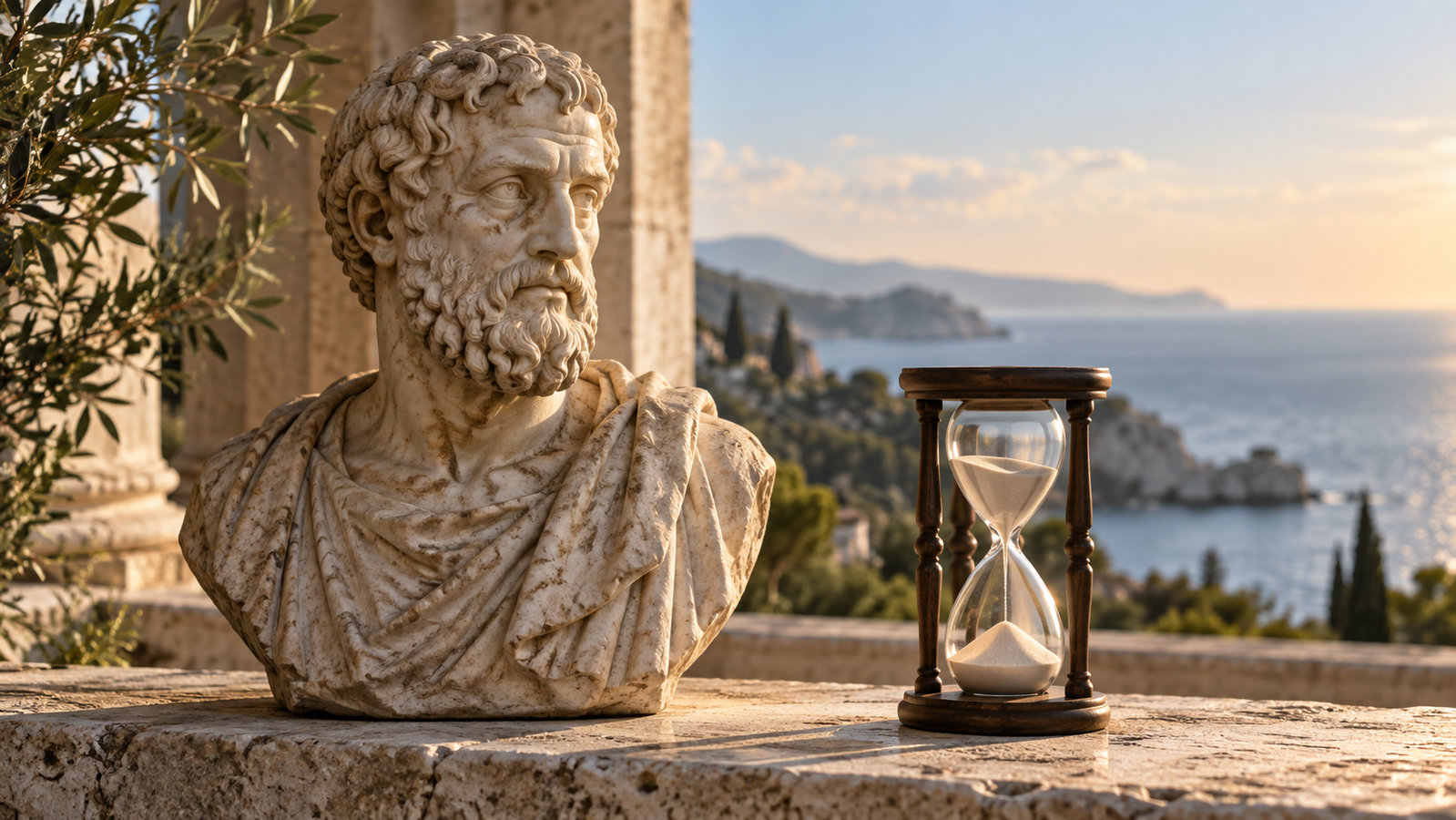
The Stoics often reflected on death because they saw it as an important part of the discussion about life. People know that their time is limited, yet usually make plans as though there will always be another opportunity ahead. They may postpone an important conversation, spend a long time waiting for the right circumstances, or spend years doing something that seems meaningless.
Awareness of death brought the Stoics back to a simple question — how to live the time available now. They were interested in human actions, relationships with loved ones, and the ability to remain calm in the face of what cannot be changed.
This explains the connection between Stoicism and the idea of memento mori. This reminder of mortality helps people see life more clearly and pay closer attention to what fills it.
What the Stoics considered important in life
Stoicism originated in ancient Greece. Its ideas were later developed by Seneca, Epictetus, and Marcus Aurelius. Despite their differences, the teaching continued to focus on how a person can live with dignity in a world where much happens independently of individual wishes.
For the Stoics, a good life was primarily connected with character and actions. They valued sound judgment, justice, courage, and moderation. They brought these qualities together under the term “virtue.”
This term refers to things that are quite easy to understand. People can think through their decisions, act honestly, consider the interests of others, and maintain their principles in difficult circumstances. The Stoics regarded these qualities as the highest good.
A long life, wealth, and recognition may be desirable, but they do not, by themselves, reveal how someone has lived. A person can achieve success and cause considerable harm to others. A person can also live an ordinary, unremarkable life and be remembered with affection.
The Stoics’ reflections on death were therefore closely connected with the question of what makes up a life. Both the years lived and the actions that fill them matter.
Death as a natural part of life

Human beings remain part of nature
The Stoics began from the idea that human beings belong to nature and are subject to its general conditions. A person is born, grows, changes, and eventually dies. Mortality accompanies human life from the very beginning.
This perspective helped them see death as a part of existence shared by all people. It affects those who have lived peacefully as well as those whose lives have been full of difficulties. Neither social standing nor achievements exempt anyone from this condition.
The inevitability of death and the time when it occurs are different matters. People know that their lives will end, but usually do not know when. This uncertainty makes the subject of death particularly difficult.
For the Stoics, acceptance began with acknowledging this fact. Life is limited, and its duration is not entirely within human control.
Why the Stoics continued to value life
The Stoics generally regarded life and health as preferable. Caring for oneself, seeking to avoid danger, and wishing to spend more time with loved ones all had a place in their teaching.
At the same time, they associated the greatest evil with wrongful actions — cruelty, injustice, and deception. Death itself does not make a person worse or turn a life lived with dignity into a bad one.
For example, the end of a life does not erase the fact that a person loved, helped others, or acted honestly. Those actions have already become part of that person’s life and have affected others.
Stoic acceptance of death could therefore coexist with the desire to live. A person takes care to preserve life while understanding that even the most reasonable efforts cannot ensure immortality.
Fear of death and what depends on the individual
What lies behind fear
The Stoics paid attention to the connection between an event and our thoughts about it. People can perceive the same fact differently because they give it different meanings.
Different concerns can also lie behind the fear of death. A person may fear separation from loved ones, the unknown, or not having enough time to carry out their plans. Sometimes the very thought of familiar life coming to an end causes anxiety.
In the Stoic understanding, fear grows when death is seen as the most terrible evil, one that completely deprives everything else of value. A person may then begin to judge their entire life through the anticipation of its end.
Stoic thought offers another perspective on this connection. If life has value because of love, justice, and worthy actions, its finite nature does not, by itself, destroy that value. Something temporary can still be important.
A calm attitude toward death was nevertheless a philosophical ideal. Understanding mortality does not mean that a person immediately stops feeling afraid or easily accepts every loss.
The limits of human control
One of the main distinctions in Stoicism concerns what depends on the individual and what lies beyond their control.
People can think through their decisions, choose their words, care for others, and take responsibility for their own actions. But they cannot fully control external events, other people’s decisions, or the length of their lives.
This distinction is especially clear in relation to the future. People can make reasonable plans and prepare for possible difficulties. Yet the outcome always depends on more circumstances than any one person can account for.
The Stoics connected calmness with acknowledging this boundary. Responsibility for one’s actions remains, even when there is no complete certainty about the outcome.
| Stoic idea | What it means |
|---|---|
| Life is finite | Mortality is a condition shared by all human beings |
| Not everything depends on the individual | Reasonable decisions can influence the future but do not provide complete control over it |
| Actions matter | The dignity of a life is connected with how a person treats others and acts |
| Fear is connected with beliefs | Thoughts about what death means play a part in how it is experienced |
| The present deserves attention | The life available to a person is happening now, although its continuation remains uncertain |
Accepting the inevitable and caring for life
In Stoicism, accepting death is connected with acknowledging reality. A person may wish for a long life, but that wish does not remove mortality. Constant inner resistance to this condition does not, by itself, change it.
At the same time, caring for life remains part of reasonable conduct. People can look after themselves, support loved ones, fulfil their obligations, and try to prevent what is within their ability to prevent.
For the Stoics, effort and outcome had different significance. A person can pay much closer attention to their own decision than to all of its consequences. They do what they consider reasonable while allowing for the possibility that events may unfold differently.
For example, someone prepares for an important undertaking, but circumstances change and the plan does not succeed. A Stoic assessment considers both the outcome and how honestly and conscientiously the person acted. Failure alone does not make their efforts meaningless.
This attitude also extended to life as a whole. Its uncertain duration leaves room for plans, care, and participation in the affairs of others.
Memento mori and awareness of mortality
The meaning of the phrase
The Latin phrase memento mori is usually translated as “remember death.” Its connection with Stoicism lies primarily in the idea it expresses — awareness that human life is limited.
Stoic authors regularly returned to this thought. Reminders of mortality helped them assess their desires, anxieties, and activities with the finite nature of time in mind.
Many things seem extremely important in everyday life. A person may spend a long time worrying about others’ opinions, seeking to prove their superiority, or postponing what truly matters to them. The thought of death changes the perspective on these concerns.
The question of how much attention they deserve becomes especially clear when people remember that their time is not endless. Some ambitions retain their importance, while others begin to seem less significant.
The aspects of life this idea brings into focus
In the Stoic understanding, awareness of death is connected with several themes.
- Time. Each day becomes part of the life already lived. Waiting for better circumstances also takes time that can no longer be recovered.
- Actions. People may not know how many years they have left, but they are already expressing their character through specific decisions.
- Relationships. The opportunity to be with loved ones is limited. Time together has value while those relationships continue.
- Desires. Awareness of life’s limits helps reveal the place of recognition, rivalry, and external achievements in relation to other aspects of life.
The meaning of this idea becomes clear in ordinary events. A conversation, a promise kept, or an act of care may seem like small things. Yet such things make up much of human life.
Life’s finite nature and the value of time
The Stoics considered the distinction between the number of years lived and what fills those years important. A person can be constantly busy and still feel that life is passing them by.
This happens when everything meaningful is postponed. Time with loved ones is put off until urgent tasks are finished. A favourite activity is delayed until free time becomes available. The chance to live peacefully is deferred until all difficulties disappear.
Yet waiting is also part of life. While a person prepares for the future, the present is already becoming the past.
The Stoics paid attention to this feature of time. A day that has passed cannot be lived again. Future decisions can be changed, but a period of life that has already gone cannot be brought back.
The value of time is not, however, reduced to the amount accomplished. From the Stoic perspective, the quality of actions, attention to other people, and the ability to respond reasonably to events matter. An ordinary day can be meaningful even when nothing remarkable has happened.
The future remains important, and planning for it is natural. But a life lived with dignity is made up of actions performed in the present. It does not necessarily begin with a special moment after which ideal conditions finally appear.
The Stoic attitude toward the death of loved ones
Attachment and the possibility of loss
Accepting one’s own mortality and acknowledging the mortality of a loved one can be equally difficult. People may understand that everyone dies and still find it almost impossible to imagine losing someone close to them.
The Stoics extended the idea of life’s limits to relationships as well. Love, friendship, and family bonds exist between people whose lives are limited. No one is promised that loved ones will always be there or that events will happen in the expected order.
This perspective leaves room for recognising the value of relationships. Spending time together matters simply because it takes place between people who are dear to one another. Its temporary nature makes the importance of shared days and experiences especially clear.
After a loved one dies, the bond itself changes. New conversations and shared events are no longer possible, but memories remain, along with the influence that person had on the lives of others.
Grief and the pursuit of calm
The Stoic ideal was demanding. These philosophers sought a state in which a person could remain reasonable even in the face of a profound loss.
They nevertheless distinguished between the initial emotional response and subsequent thoughts about what had happened. News of a death can shock a person and bring tears and pain. Conclusions about one’s own life and future then become part of that experience.
One such conclusion may be the belief that everything has permanently lost its meaning after the loss. The Stoics paid close attention to thoughts of this kind because they associated them with the continuation of emotional suffering.
For them, the pursuit of calm meant being able to acknowledge what had happened and retain the ability to live with dignity. This was a rigorous philosophical ideal that the Stoics themselves sought to attain. Actual people, including members of this school, could experience deep grief at the death of those dear to them.
The Stoic tradition also had room for tears and affectionate remembrance. A person’s significance in our lives is not exhausted by the pain of losing them. It includes everything experienced together, what they taught us, and what they left behind in their relationships with others.
Stoic reflection on the death of loved ones therefore brings attention back to both the loss and the bond itself. The person has died, but their part in the lives of others has already been lived and remains part of those people’s histories.
Key points
- The Stoics regarded death as a natural part of human life.
- They connected the greatest value with character, justice, and worthy actions.
- Acceptance of mortality coexisted with care for life and the wish to preserve it.
- The Stoics distinguished between personal decisions and circumstances that a person cannot fully control.
- In their understanding, fear of death is connected, among other things, with beliefs about its meaning.
- Memento mori expresses awareness of life’s finite nature and attention to the present.
- The value of time is shaped both by its limits and by what fills the days already lived.
- The Stoic ideal of calm allowed room for initial pain, tears, and remembrance of loved ones.
Updated : 2026-09-30